
I once had the privilege of walking alongside a wise and humble cardiologist on a trek.
It was a calm afternoon on the cool hills. The path looked unintentionally intentional—paved by humans walking over and over again on patches of wilting grass. The sides were splashed with tall trees. The scent was woody, as you can imagine, and quite pleasant. We had just crossed a well and a water storage plant built by the British eons ago. Everyone in our trekking group of about fifteen sang praises about the engineering feat in such an isolated hill. We passed wide, hollow tree trunks whose grains were divine and hinted at all the years they had stood strong. Then we walked through a patch of land with exotic chilli plants. All our eyes were on the ground, skimming through it for any other exotic specimen we might find.
That’s when the good doctor noticed a creeper.
It seemed quite ordinary to me, like a garden ivy. But the good doctor insisted it was special. I stopped to see what it was. I don’t remember his exact words, but the summary was:
“It is impossible for this plant to grow and thrive in this environment. It must have given up and be dead by now. But still, nature finds a way!”
I was right next to him, and I am a plant lover. However, for some reason, instead of gathering more information about the identity of the plant, my thoughts drifted to a very similar human problem. I asked him, “Then why do you think humans give up? Why do people commit suicide when they could find a way?” His answer was painful but screamed truth. “People commit suicide because there is no way out. Think of a farmer who got a loan to buy seeds and fertilisers. Now what if the rain gave up on him? He doesn’t have savings. Two years of nothing. His spouse deserts him. What do you do? There is no way out!”
This got me thinking. He exposed the potent tint of judgmental attitude I had towards struggling people.
I realised there was something I had not accounted for in my analysis of the situation—a state of mind where one sees no way out.
I was reminded of this incident yesterday when I was watching an excerpt from a podcast. The guest was sharing the story of a top-level IT professional who had recently lost his job. The guest called him “a rock star from top IIT who has made his money.” He didn’t have to work another day to earn money. He had built a huge mansion in a posh area in Bangalore. But now, because he was jobless, he was being disrespected day in and day out by his wife and his own son. The guest recalled him saying, “Even if I had worked and worked and died of a heart attack, the pain would be less compared to what I am going through each day.” All I could think of was a rich man who had everything, but was in a state of mind where he saw no way out.
This morning, I went to my tiny balcony garden.
I had bought a rose plant a few months ago from a local nursery. It looked great at the nursery, but once it was shifted to a new pot and new hands, let’s just say it didn’t do so well. The leaves dried and withered despite me doing my best to water and nourish it. However, I didn’t dispose of the stem like I usually do—because I was afraid my dear husband, Finney, would add this plant to his list of my casualties. He likes to fondly call me the “Fish & Plant serial killer.” Anyway, I left the stem intact for months and planned to remove it once the last leaf fell off.
We were out of town and came home after a few days. I went to check on my plants, and that is when I saw something beautiful.
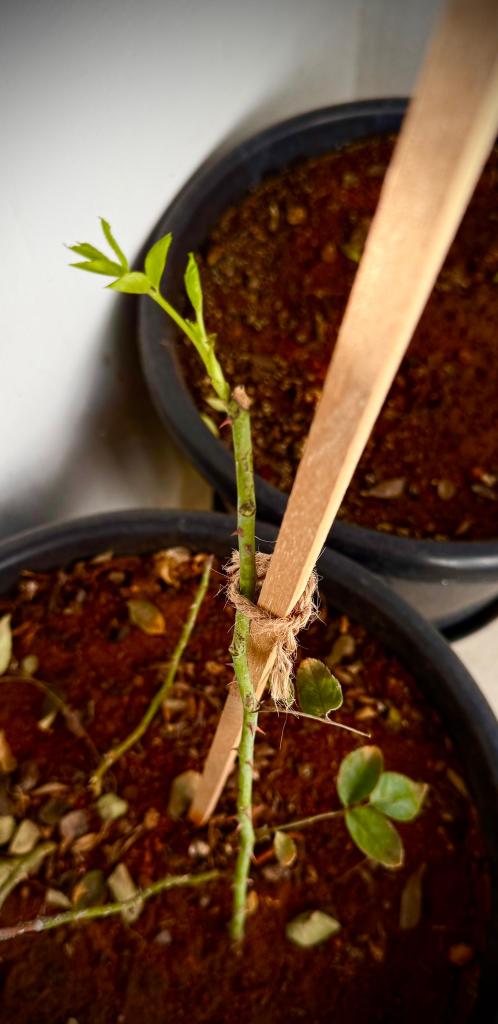
My picture says it all.
I’m glad I didn’t pull out the stem.
Then again, the good doctor’s words hit me hard:
Nature finds a way!
I just want to repeat those words to you if you are going through a tough time and have already entered a state of mind where you see no way out.
Don’t give up yet.
Keep hanging in there.
If a creeper/ rose plant can find a way, you—a special creation made in the image of God—will find a way.
You will find a way. 🧡
Love,
Linda


Leave a comment